Seamless Cactus Patterns: Practical, Versatile, and Ready When You Are
If you’ve ever spent 20 minutes searching for a background that doesn’t tile awkwardly—or worse, had to manually crop and align a cactus motif just to get it to repeat across a greeting card or fabric swatch—you already know the value of a truly seamless pattern. Seamless Cactus Patterns solves that quietly, reliably, and beautifully. It’s not just another clipart download. It’s a thoughtfully built, high-resolution design asset created for people who need consistency, flexibility, and visual warmth—without the technical friction.
What “Seamless” Really Means in Practice
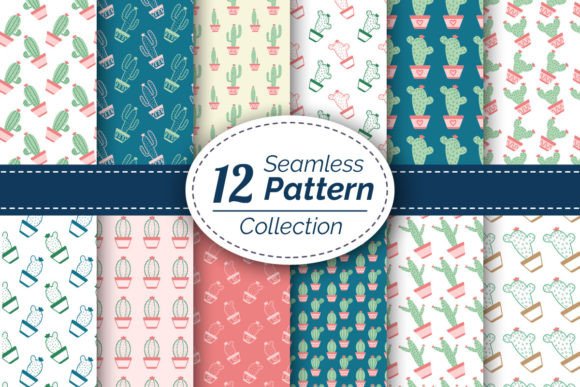
A seamless pattern repeats infinitely in all directions without visible edges, gaps, or misaligned stems. That means when you tile it across a large surface—like wrapping paper, a t-shirt print, or a book cover—it flows naturally, like desert air over saguaro silhouettes at dusk. This isn’t achieved by stretching or blurring; it’s crafted with intentional spacing, balanced negative space, and botanical rhythm. Each cactus shape sits comfortably next to its neighbor—no overlapping, no clipping, no awkward white lines between tiles.
The included 12 JPG files (12 x 12 inches, 300 dpi, 3600 x 3600 px) give you room to scale confidently. Whether you’re printing on letter-sized stationery or covering a 24-inch gift box, you’ll retain crisp detail. No pixelation. No guessing whether your printer will handle the resolution. Just open, place, and go.
Where This Pattern Fits Into Real Creative Workflows
Think about the last time you designed something personal or professional—and how much time you spent tweaking backgrounds:
- Scrapbookers use it as a subtle base layer behind photos of Southwest road trips or family reunions in Arizona. The pattern adds texture without competing—especially when printed on matte cardstock or layered under vellum cutouts.
- Small business owners running a plant shop, ceramic studio, or eco-friendly lifestyle brand apply it to packaging tape, tissue paper, or thank-you cards. Customers notice the care—not just in the product, but in how it arrives. One Etsy seller told us her repeat customers specifically mention the “desert vibe” of her unboxing experience.
- Educators and homeschoolers print it onto flashcards for botany units, or use it as a calming background for printable worksheets on desert ecosystems. The organic shapes help ground learning visually—without the visual noise of cartoonish clipart.
- Freelance designers drop it into Canva layouts for client social media posts, embed it into InDesign templates for editorial spreads, or import it into Procreate as a custom brush texture for hand-lettered quotes. Its neutral-but-characterful tone works across minimal and playful aesthetics alike.
Why Format Choice Matters More Than You Think
Getting a pattern in JPEG format may seem basic—but it’s intentional. Unlike vector files that require software knowledge to edit, or PNGs with transparent backgrounds that can create unintended stacking issues, these JPGs are universally compatible. They open in Photoshop, Affinity Photo, GIMP, Canva, Microsoft Word, Google Slides—even older versions of Illustrator if you embed rather than link. No font dependencies. No missing layers. No “please update your software” messages.
And because each file is exactly 12 x 12 inches at 300 dpi, scaling is predictable. Want to make a 6-inch square tile? Resize to 50%—and still land at 1800 x 1800 px, well above standard print thresholds. Need a 24-inch banner? Tile two copies side-by-side, and the seam disappears. That reliability saves hours during production—especially when deadlines loom or clients request last-minute size changes.
Real Scenarios Where This Pattern Makes a Difference
Consider Maria, a freelance illustrator launching her first line of greeting cards. She needed a cohesive series with desert-themed motifs—but didn’t have time to draw 12 unique repeating patterns from scratch. She used Seamless Cactus Patterns as a base, adjusting saturation and adding hand-drawn accents on top. Her launch sold out in three days, and several buyers commented on how “calm” and “cohesive” the collection felt.
Then there’s James, who runs a small-batch candle company. He printed the pattern onto kraft paper labels and used it as a background for his holiday gift boxes. Because the design reads clearly even at small scale—and doesn’t rely on fine linework—he avoided costly plate reprints when his printer flagged earlier designs for low contrast.
Even educators benefit quietly: A middle school science teacher printed the pattern onto laminated posters for her “Adaptations in Arid Environments” unit. Students traced cactus shapes to study water retention structures—and the consistent, clean outlines helped them focus on function, not drawing skill.
What to Keep in Mind Before You Use It
While Seamless Cactus Patterns is flexible, it’s not magic. A few practical notes:
- Color adjustment is expected—and encouraged. The JPGs ship in warm, natural tones (think dusty sage, terracotta, soft sand), but they respond well to hue/saturation tweaks in any editing app. Try cooling the palette for a modern spa brand, or deepening the greens for a nursery theme.
- It’s not a logo or standalone icon set. If you need isolated cactus vectors for branding, this isn’t the right tool. But if you need rhythm, repetition, and atmosphere—this delivers.
- Mockups aren’t included—but that’s by design. You’ll receive only the clean, production-ready files. That keeps the download lightweight and avoids licensing complications if you’re using it commercially. You bring the context; this brings the foundation.
When Simplicity Becomes Your Strongest Design Choice
In a world full of overdesigned templates and AI-generated chaos, there’s real power in a quiet, well-made pattern. Seamless Cactus Patterns doesn’t shout. It supports. It frames. It connects. Whether you’re wrapping a birthday present for a friend who loves succulents, designing a conference badge for a sustainability summit, or creating classroom visuals that feel grounded and inviting—it works because it respects your time, your tools, and your intent.
You don’t need special training to use it. You don’t need permission to adapt it. You just need a project where warmth, repetition, and subtle character matter—and suddenly, what started as a simple download becomes part of something more intentional.
Thank you—and happy designing.