Iconic Black Friday Seamless Patterns: A Practical Guide for Designers, Marketers, and Small Business Owners
Every November, design teams, marketing departments, and independent creators begin preparing for one of the most visually saturated retail events of the year: Black Friday and Cyber Monday. Amid tight deadlines and high expectations, reusable, on-brand assets become indispensable—not just for speed, but for consistency. That’s where Iconic Black Friday Seamless Patterns enter the workflow: a thoughtfully curated background set designed not as decorative afterthoughts, but as functional, production-ready tools.
What Makes These Patterns “Seamless”—and Why It Matters
A seamless pattern repeats infinitely in all directions without visible seams, edges, or alignment breaks. This isn’t just an aesthetic preference—it’s a technical requirement for scalable applications. Whether you’re designing a social media banner that must resize across Instagram, Facebook, and Pinterest—or generating custom packaging mockups for 20+ SKUs—non-seamless graphics introduce awkward tiling artifacts, manual patching, and revision loops.
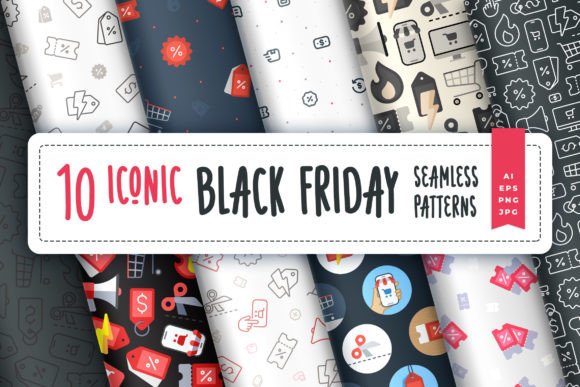
The Iconic Black Friday Seamless Patterns collection delivers ten such patterns, each engineered with precise tile boundaries and balanced visual weight. Unlike generic holiday-themed vectors, these integrate recognizable seasonal motifs—shopping bags with price tags, stylized “50% OFF” ribbons, pixel-perfect shopping carts, abstracted credit card icons, and minimalist countdown clocks—all composed to avoid visual fatigue at scale. The result? Backgrounds that support content rather than compete with it.
File Formats That Match Real-World Production Needs
Design handoffs rarely happen in a vacuum. A single campaign may involve print vendors requiring vector precision, web developers needing transparent PNGs, and social media managers uploading JPGs directly into scheduling tools. The Iconic Black Friday Seamless Patterns set anticipates this complexity by including four distinct file formats per pattern:
- AI files — Fully editable Adobe Illustrator documents with layers preserved, ideal for designers who need to recolor, reposition, or isolate elements;
- EPS v10 files — Backward-compatible vector exports suitable for legacy print workflows, including large-format signage and offset printing;
- JPG patterns — High-resolution (300 DPI), RGB-optimized raster files optimized for digital ads, email headers, and CMS uploads;
- PNG patterns — Transparent-background versions for overlaying on photos, video thumbnails, or gradient backgrounds without clipping masks.
Each format is named consistently (e.g., bf_cart_tile_ai.ai, bf_cart_tile_png.png) and tested across common software—including Affinity Designer, Figma (via import), and Canva (using PNG/JPG)—to ensure predictable rendering. No conversion scripts or format guesswork required.
Use Cases Across Disciplines
The versatility of Iconic Black Friday Seamless Patterns becomes apparent when viewed through the lens of actual user workflows—not hypothetical ones.
For E-commerce Teams
Online retailers often refresh category pages, flash sale banners, and product comparison grids during peak season. Rather than commissioning custom illustrations for each section, teams use these patterns as subtle, branded textures beneath product grids or behind hero text. One boutique clothing brand applied the “discount tag” pattern at 15% opacity behind its “Deals” navigation bar—creating visual cohesion without obscuring readability. Because the pattern is seamless and layered, it adapts automatically to responsive breakpoints.
For Educators and Trainers
Instructors teaching digital marketing or graphic design frequently assign real-world briefs: “Design a Black Friday email series for a local bookstore.” Students using Iconic Black Friday Seamless Patterns gain exposure to industry-standard asset management—naming conventions, format selection logic, and accessibility considerations (e.g., avoiding low-contrast patterns behind body text). In one university capstone course, students built interactive prototypes using the PNG patterns as background layers in Figma, then documented their rationale for choosing EPS over AI when exporting for client presentation decks.
For Small Business Owners Without Design Support
Many solopreneurs rely on DIY tools like Canva or VistaCreate. While those platforms offer built-in templates, they rarely include truly customizable, seasonally relevant patterns that align with brand colors. With the Iconic Black Friday Seamless Patterns, users can upload a PNG, adjust blend modes (e.g., Multiply for dark text legibility), and scale the tile size to fit any layout—no design degree needed. A handmade soap maker used the “gift box” pattern as a subtle background for her Etsy shop banner, then reused the same file—resized and recolored—to create matching Instagram Story highlights.
Design Integrity Meets Seasonal Relevance
Not all Black Friday visuals age well. Overly literal interpretations—think exploding confetti, cartoonish dollar signs, or aggressive red-and-black gradients—can feel dated by mid-December. The Iconic Black Friday Seamless Patterns collection avoids trend dependency through intentional abstraction. For example, the “countdown clock” motif uses clean geometric segments instead of realistic numerals; the “shopping cart” is reduced to essential contours, allowing it to function equally well as a background texture or a subtle watermark.
This approach supports longevity: while the patterns are unmistakably tied to the shopping season, their restrained execution means they won’t clash with evolving brand guidelines. A tech startup reused the “credit card stripe” pattern—originally intended for finance-related promotions—as a textured divider in its Q4 investor report, simply by shifting its hue to match corporate blues.
Accessibility and Readability Considerations
Background patterns influence how users perceive foreground content—especially those relying on screen readers or low-vision accommodations. High-contrast, busy tiles can interfere with text legibility and trigger cognitive overload. Each pattern in the Iconic Black Friday Seamless Patterns set was evaluated using WCAG 2.1 contrast ratio guidelines against common text colors (black, white, charcoal, and navy). Patterns were adjusted to ensure minimum 4.5:1 contrast when overlaid at standard opacities (20–30%).
Additionally, no pattern contains repetitive motion cues or strobing effects—important for users with photosensitive epilepsy. The JPG preview file included in the set demonstrates each pattern at three standard scales (small, medium, large) and two opacity levels, helping users assess visual density before implementation.
Integration Into Existing Workflows
Adopting new assets shouldn’t require overhauling established systems. Teams using Adobe Creative Cloud can drag AI or EPS files directly into Libraries for team-wide access. Developers working with CSS can convert the JPG or PNG patterns into data URIs for lightweight, embeddable backgrounds—eliminating HTTP requests. Content managers using WordPress or Shopify can upload PNGs to media libraries and apply them via custom CSS or theme editor tools.
One regional grocery chain integrated the “price tag” pattern into its internal digital signage system by converting the EPS into SVG, then applying background-repeat: repeat; in their display template. Because the tile origin was precisely aligned, the pattern rendered identically across 47 store monitors—without manual calibration.
Why Ten Patterns—Not More, Not Less
Ten represents a balance between variety and manageability. Too few options risk visual repetition across channels; too many invite decision fatigue and inconsistent usage. The selection covers complementary themes—transactional (cart, card), promotional (tag, ribbon), temporal (clock, calendar), and symbolic (gift, bag)—without overlapping conceptually.
Each pattern was stress-tested across five common applications: email headers, social post backgrounds, printable flyers, website section dividers, and presentation slide masters. Patterns that performed poorly in more than two contexts were refined or replaced. The final set reflects iterative feedback—not theoretical assumptions.
Looking Beyond Black Friday
While designed for November’s retail surge, these patterns hold value year-round. The “gift box” tile works for holiday campaigns beyond Black Friday—including small business gift guides in December or teacher appreciation in May. The “discount tag” motif adapts naturally to back-to-school sales, tax season offers, or even nonprofit fundraising appeals (“Your donation unlocks 2X impact!”).
More importantly, the collection models a sustainable approach to seasonal design: invest once in rigorously built, format-flexible assets—and reuse, reinterpret, and repurpose across cycles. That mindset shifts focus from chasing trends to building resilient visual systems.
Final Thoughts for Intentional Implementation
Patterns are never neutral. They communicate tone, hierarchy, and attention. A poorly chosen background can undermine trust; a well-integrated one reinforces clarity and professionalism—even during high-pressure sales periods. The Iconic Black Friday Seamless Patterns succeed not because they’re flashy, but because they’re dependable: technically sound, ethically considered, and practically structured for real work.
Whether you’re refining a landing page, prepping a classroom assignment, or launching your first online store, treat these patterns as infrastructure—not decoration. Test them early in your workflow. Adjust scale and opacity deliberately. Document your choices for future reference. And remember: the most iconic designs aren’t the loudest—they’re the ones that serve quietly, consistently, and without friction.