Gold Rose Patterns: Timeless Elegance, Digitally Empowered
Gold rose patterns blend botanical grace with metallic sophistication—evoking heritage craftsmanship while fitting seamlessly into modern digital workflows. Unlike fleeting design fads, this motif carries enduring resonance: roses symbolize beauty and intention; gold signals value, warmth, and refinement. Today’s creators aren’t just choosing aesthetics—they’re selecting visual languages that communicate care, quality, and quiet confidence. That’s why Gold Rose Patterns matter—not as nostalgic decoration, but as a versatile, production-ready asset for professionals who balance creativity with practicality.
Why Five Patterns? Because Flexibility Starts With Choice
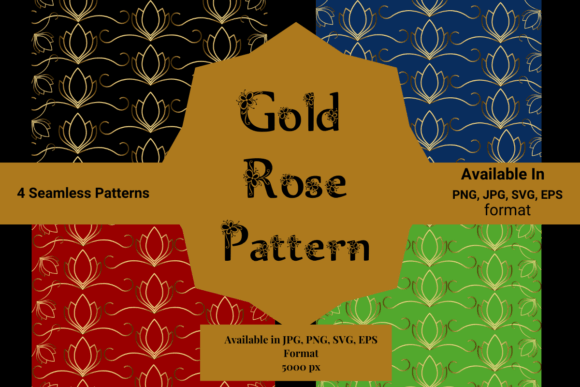
You’ll receive five distinct gold rose patterns—each thoughtfully composed, balanced, and scalable. This isn’t about quantity for its own sake. It’s about giving you real options: one with tight, repeating vines ideal for fabric repeats; another with generous negative space suited to wall decals or minimalist stationery; a third featuring layered petal textures that translate beautifully to embroidery or foil-stamped packaging. Having five variations means you can match pattern rhythm to project scale, surface texture, and audience expectation—without licensing restrictions or attribution requirements.
Digital-First Design Meets Real-World Application
No physical product ships—and that’s intentional. The files arrive in four industry-standard formats: JPG, PNG, SVG, and EPS—all at 5000px × 5000px and 300 dpi. This resolution ensures crisp output whether you’re printing a 60-inch-wide custom rug or scaling down a single motif for laser-cut jewelry packaging. SVG and EPS support vector editing, so designers can recolor stems, adjust spacing, or isolate petals in Adobe Illustrator or Affinity Designer. PNGs preserve transparency for overlays on photos or video backgrounds. JPGs offer fast loading for web mockups or client presentations.
This format diversity reflects how creative work happens today: across tools, teams, and timelines. A small-business owner might use the SVG to customize a Shopify banner, then hand the same file to a local print shop for luxury gift wrap. A textile designer could import the EPS into CAD software for seamless repeat development. An educator creating classroom décor might drop the PNG into Canva and resize it instantly for posters or digital handouts. The files don’t gatekeep—they enable.
From Surface Decoration to Strategic Expression
Roses have long carried meaning—but gold elevates them beyond ornamentation. In branding and product design, metallic accents signal premium positioning without shouting. Consider a boutique candle line using a subtle gold rose pattern on matte black labels: it conveys artisanal care and sensory richness at a glance. Or an interior designer sourcing custom upholstery fabric—this pattern adds depth and tactility to neutral palettes, supporting biophilic design principles without overwhelming a space.
What’s shifted isn’t the rose itself, but how we deploy it. Ten years ago, finding high-resolution, commercially usable floral patterns often meant sifting through low-DPI clip art or paying for restrictive subscriptions. Today, creators expect immediacy, flexibility, and ethical clarity—no hidden fees, no murky usage terms. Gold Rose Patterns meets that expectation: royalty-free, no attribution required, usable across personal and commercial projects alike.
Fitting Into Evolving Creative Routines
Remote collaboration, rapid prototyping, and multi-channel launches have reshaped creative timelines. You might sketch an idea Monday morning, mock it up Tuesday afternoon, and ship a first-run product by Friday—all without stepping into a studio. Gold Rose Patterns supports that pace. There’s no waiting for scans, no chasing permissions, no resizing headaches. You download, open, adapt, and implement—often in under ten minutes.
This efficiency matters most when attention is scarce. Freelancers juggling multiple clients benefit from assets that integrate cleanly into existing brand kits. Educators preparing lesson materials appreciate patterns that print clearly on school-grade printers. Hobbyists testing new techniques—like heat-transfer vinyl on tote bags or sublimation printing on ceramic mugs—need reliable base files that hold detail at various scales. Consistency across applications builds trust, whether you’re launching a side-hustle or refreshing your portfolio.
Practical Use Cases Across Roles
- Small business owners: Apply the pattern to custom thank-you cards, packaging inserts, or social media banners—reinforcing brand cohesion without hiring a designer for every touchpoint.
- Interior designers & stylists: Use the SVG to create seamless digital mood boards, then send the same file to a textile printer for custom pillow covers or curtain panels.
- Educators & workshop facilitators: Print large-format versions for classroom walls or cut out motifs for tactile learning activities—no copyright concerns when sharing with students.
- Bloggers & content creators: Overlay the PNG onto lifestyle photography for branded Pinterest pins or Instagram story highlights—gold tones naturally complement warm lighting and natural backdrops.
- Print-on-demand entrepreneurs: Upload the EPS directly to platforms like Printful or Gelato; the vector format ensures clean edges on everything from phone cases to throw blankets.
Quality That Scales—Without Compromise
The 5000px × 5000px canvas at 300 dpi isn’t overkill—it’s foresight. Printing a 40-inch-square blanket at 150 dpi requires only 2400px width, but having extra resolution gives breathing room for cropping, rotating, or adding subtle effects (like soft shadows or duotone filters) without pixelation. And because each pattern is built with vector foundations, you’re never locked into raster limitations. Need to stretch one motif across a 10-foot mural? Scale it. Want to isolate a single rose for a monogram? Edit it. The files grow with your ambition—not against it.
Not Just Pretty—Purposefully Designed
These aren’t decorative afterthoughts. Each of the five Gold Rose Patterns was developed with repetition integrity in mind: seamless tiling, consistent stroke weights, and harmonized gold tone values that render accurately across screens and print. That attention shows up in real ways—no visible seams on fabric swatches, no color shifts when converting from RGB to CMYK, no jagged edges when cutting with a Cricut or Silhouette machine.
That level of technical care aligns with broader expectations: audiences notice polish, even if they can’t name why. A handmade soap wrapped in paper featuring a crisp, well-aligned gold rose pattern feels more considered than one with blurry or misaligned graphics. That perception translates directly to perceived value—and ultimately, to willingness to engage, purchase, or share.
A Resource That Grows With Your Practice
Design assets should serve your growth—not constrain it. Whether you’re launching your first Etsy shop, building a client-facing brand kit, or experimenting with new mediums like resin art or ceramic decals, Gold Rose Patterns adapts. You’re not buying static images—you’re acquiring flexible visual infrastructure. And because the license covers both personal and commercial use, there’s no need to repurchase or relicense as your scope expands.
In a landscape where trends accelerate and tools evolve daily, foundational elements like thoughtful pattern design remain steady. Gold Rose Patterns doesn’t chase novelty—it supports substance. It lets you focus on what matters most: your idea, your craft, your message—expressed with elegance, efficiency, and quiet authority.