Mandala Flower Classic Patterns: A Practical Guide for Creative Professionals and Hobbyists
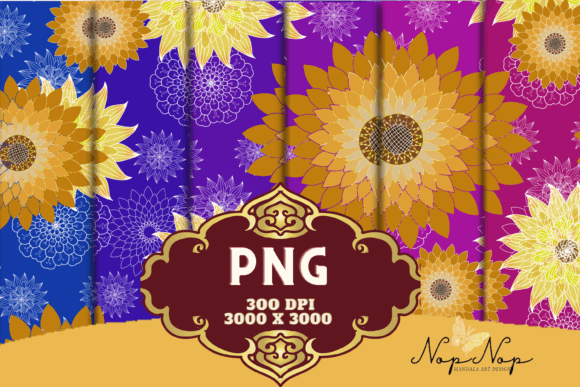
Mandala Flower Classic Patterns is a curated set of six high-resolution digital design assets—each a meticulously crafted, symmetrical floral mandala. Unlike generically generated or AI-scaled motifs, these patterns reflect traditional compositional discipline: balanced radial geometry, layered petal forms, and intentional negative space that supports both visual rest and functional adaptability. You’ll receive six PNG files, each sized at 3600×3600 pixels—equivalent to a crisp 12×12 inch print at 300 dpi. That resolution ensures fidelity across physical and digital applications without pixelation, stretching, or quality loss.
What Sets Mandala Flower Classic Patterns Apart
Not all mandala pattern sets deliver equal utility. Many rely on simplified vector outlines or low-contrast repeats better suited for mood boards than production use. Mandala Flower Classic Patterns avoids those limitations by prioritizing three practical attributes: resolution integrity, design cohesion, and format readiness. Each file is delivered as a transparent-background PNG—no clipping masks, no embedded watermarks, no layer restrictions. That means immediate drag-and-drop compatibility with tools like Adobe Photoshop, Affinity Designer, Cricut Design Space, or Canva. There’s no need to trace, re-rasterize, or adjust blending modes just to isolate the motif.
The floral interpretation also distinguishes this set from more geometric or tribal mandala libraries. Petal density, stamen detail, and subtle tonal gradations are calibrated for warmth and approachability—not austerity or abstraction. That makes them especially effective in contexts where emotional resonance matters: birthday cards for children, wellness-themed invitations, or handmade gift wrap meant to feel personal rather than decorative.
Comparing Use Cases: Where These Patterns Excel (and Where They Don’t)
Mandala Flower Classic Patterns performs consistently well in projects requiring clean, repeat-ready elements at print-grade resolution. For scrapbooking, the 3600×3600 px size allows seamless tiling across 12×12 inch layouts—or precise cropping into smaller tags, journaling spots, or photo mats. When used as washi tape bases, the symmetry ensures clean edge repeats even when scaled down to 0.5 inches wide. As blog backgrounds or photography backdrops, the transparency enables soft overlay effects without obscuring underlying text or subject matter.
However, they’re not optimized for every scenario. If you’re designing large-format wall murals spanning 4×8 feet, a single 3600×3600 px file would require upscaling that risks visible interpolation—especially in fine petal edges. In those cases, a true vector-based mandala library (with editable paths and infinite scalability) would be more appropriate. Similarly, if your workflow depends heavily on color-swapping via hue/saturation layers, PNGs limit flexibility compared to layered PSDs or SVGs with named swatches.
Strengths in Real-World Applications
- Scrapbook pages: The consistent 12×12 inch native size aligns directly with standard scrapbook paper dimensions—eliminating guesswork when resizing or masking.
- Birthday and greeting cards: Floral mandalas convey celebration without cliché; their symmetry reads as intentional, not generic—ideal for handmade or small-batch printing.
- Gift wrap and tags: Because each pattern fills the full square canvas, cutting custom shapes (e.g., circles for ornaments or hexagons for gift toppers) preserves proportional balance.
- Blog and social media graphics: Transparent PNGs integrate cleanly over photos or gradients—no white boxes, no alignment friction.
How Mandala Flower Classic Patterns Fits Within Broader Design Resource Categories
Digital pattern libraries fall along several axes: format (PNG vs. SVG vs. JPEG), resolution (web-optimized vs. print-ready), stylistic intent (minimalist, botanical, ethnic, abstract), and licensing scope (personal use only vs. commercial redistribution). Mandala Flower Classic Patterns sits squarely in the mid-tier of that landscape: it’s not free, but it’s not subscription-based; it’s not infinitely scalable, but it’s resolution-robust for most common creative outputs; and while it’s rooted in tradition, it avoids cultural appropriation through abstraction—focusing on universal floral geometry rather than sacred iconography.
Compared to royalty-free stock pattern sites, this set offers curation over volume. You won’t find 200+ variations—but you will find six that were selected and refined for interoperability. That tradeoff favors users who value consistency and time savings over exhaustive choice. It’s also distinct from AI-generated mandala packs, which often lack deliberate rhythm or organic flow—producing motifs that look algorithmically correct but visually static.
Decision Factors: When to Choose This Set (and When to Look Elsewhere)
Consider Mandala Flower Classic Patterns if your priority is immediate usability across mixed-media workflows—especially if you regularly move between print and digital output. It’s well-suited for crafters producing limited runs (e.g., 10–50 hand-assembled cards), educators creating classroom materials, or bloggers building cohesive visual identities without hiring a designer.
It’s less ideal if you need:
- Custom color control: Since colors are baked into the raster image, changing a dominant hue requires manual recoloring—not a simple palette swap.
- Large-scale fabrication: For signage, fabric printing, or vinyl decals exceeding 24 inches in any dimension, vector source files remain the safer technical choice.
- Dynamic repetition: While the patterns tile cleanly, they aren’t built as seamless tiles with offset repeats—so generating infinite backgrounds in CSS or Figma may require additional editing.
Also consider your existing toolkit. If you work primarily in Procreate or iPad-first apps, the 3600×3600 px size is generous—but ensure your device has enough RAM to handle multiple layers at that resolution. On older hardware, opening all six files simultaneously could slow performance. Opening one at a time—and saving resized versions for specific tasks—is a pragmatic workaround.
Practical Integration Tips
For best results, treat each file as a modular asset—not just a background. Try these approaches:
- Use one pattern as a focal frame around a photo, then reduce opacity to 15–20% for subtle texture.
- Import into a vector tool and trace key elements to create custom clipart—retaining the original symmetry while gaining editability.
- Layer two patterns with different blend modes (e.g., Multiply + Overlay) to generate nuanced tonal depth without adding noise.
- Convert to grayscale and apply duotone effects in Photoshop for vintage or monochrome stationery designs.
Because the files are resolution-matched to standard print dimensions, they also simplify outsourcing. If you outsource printing to services like Printful, Vistaprint, or local print shops, you can upload files directly—no resizing, no DPI warnings, no last-minute panic about bleed or margins.
Final Considerations for Informed Selection
Mandala Flower Classic Patterns isn’t a universal solution—but it is a highly focused one. Its value emerges most clearly when matched to real constraints: tight deadlines, mixed output needs, and an expectation of professional-grade polish without professional-grade overhead. It bridges the gap between amateur accessibility and pro-level output, offering clarity where many alternatives offer only abundance.
If you’ve previously worked with lower-resolution mandala packs and noticed blurriness on printed cards—or struggled to get clean edges on die-cut tags—this set addresses those pain points directly. Conversely, if your projects demand deep customization, multilingual symbolism, or integration with automated design systems, evaluating vector-based or parametric mandala generators may yield better long-term flexibility.
Ultimately, Mandala Flower Classic Patterns serves users who understand that good design resources aren’t measured solely by quantity or novelty—but by how quietly and reliably they support intention.