Cryptocurrency Patterns Pack: Design Resources for Visualizing Digital Finance
Visual communication plays a critical role in how we understand, teach, and represent complex systems—especially in rapidly evolving domains like cryptocurrency. The Cryptocurrency Patterns Pack responds to this need with a curated set of 17 high-resolution, seamless digital assets designed specifically for creators, educators, developers, and communicators working at the intersection of finance, technology, and design.
What Makes These Patterns Distinctive?
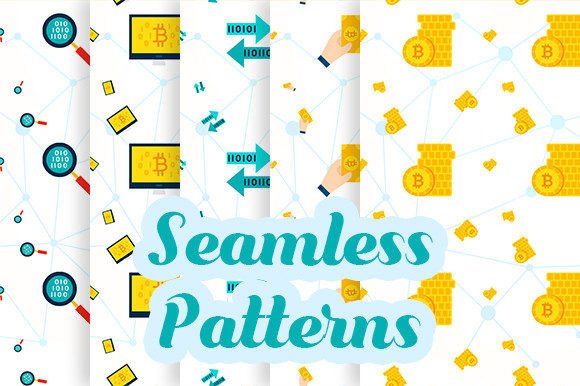
Unlike generic abstract backgrounds or algorithmically generated textures, the Cryptocurrency patterns in this pack are conceptually grounded. Each pattern reflects visual motifs associated with blockchain infrastructure—interlocking nodes, cryptographic hash sequences, decentralized network topologies, transaction flow rhythms, and consensus-driven symmetry. They avoid literal iconography (like Bitcoin logos or wallet illustrations), instead focusing on abstraction that evokes structure, security, and motion without limiting interpretive flexibility.
The technical specifications reinforce their utility: every file is delivered in PNG format, preserving transparency where needed, and rendered at 4500 px × 4500 px—a dimension large enough to scale across print media, presentation decks, website hero sections, and digital signage without pixelation. At 300 DPI, they meet professional publishing standards for both screen and offset printing—a detail that matters to designers preparing investor reports, academic posters, or exhibition graphics.
Seamless Patterns Enable Scalable, Cohesive Design Systems
A defining feature is their seamless tiling capability. This means each background repeats infinitely without visible seams or alignment breaks—essential when applying textures to large-format layouts, UI component libraries, or responsive web elements. For example, a product manager building a dashboard for a DeFi analytics platform might use one of these patterns as a subtle backdrop behind data cards, ensuring visual continuity across varying screen sizes. A university lecturer preparing lecture slides on smart contract architecture could apply a low-opacity overlay to emphasize modular relationships between layers of code and execution environments.
This seamlessness also supports iterative experimentation. Designers can adjust tile spacing, rotation, or blending modes in tools like Figma, Adobe Photoshop, or CSS background properties—without needing to re-export or manually patch edges. That flexibility reduces production time while maintaining aesthetic integrity, especially in collaborative workflows where multiple stakeholders contribute to visual assets.
Color Strategy Across the Collection
The colorful backgrounds included are not arbitrary palettes. They follow intentional chromatic logic: cool gradients (deep indigo to slate gray) suggest trust, stability, and cryptographic depth; energetic accent combinations (teal-to-cyan pulses, violet-to-magenta transitions) mirror volatility charts and real-time transaction feeds; muted metallic tones (brushed copper, oxidized silver) evoke hardware wallets and physical crypto storage devices.
Importantly, color contrast meets WCAG 2.1 AA standards in most base configurations—making them suitable for educational materials, accessibility-conscious interfaces, and public-facing documentation. One pattern, for instance, uses a high-contrast black-and-electric-blue lattice that remains legible even when overlaid with white text at 16px size, supporting inclusive information delivery without additional contrast adjustments.
Real-World Applications Across Disciplines
Different users engage with the Cryptocurrency Patterns Pack in ways shaped by their goals, tools, and audiences. Below are representative examples drawn from actual implementation scenarios:
- Educators and Researchers: A doctoral candidate in fintech used three patterns—one representing proof-of-work cycles, another illustrating Merkle tree branching, and a third evoking zero-knowledge proof obfuscation—to visually scaffold a conference presentation on consensus mechanisms. The consistent resolution and color language helped unify otherwise dense technical content.
- UX Designers and Product Teams: A startup developing a cross-chain asset tracker integrated a subtle hexagonal mesh pattern into its onboarding flow. Because it was seamless and transparent-capable, the team applied it as a CSS background-image with
background-size: 200px, creating rhythmic visual breathing room between form fields without competing with interactive elements. - Marketing Professionals: An agency crafting a campaign for a Layer 2 scaling solution selected a dynamic ripple-pattern variant to symbolize transaction throughput expansion. Printed at full resolution on vinyl banners for a tech summit, the pattern retained crispness from 1 meter to 10 meters viewing distance—something lower-DPI alternatives failed to achieve.
- Hobbyists and Independent Creators: A digital artist producing NFT collection previews layered two patterns—one as a base texture, another inverted and set to multiply blend mode—to generate organic-looking “blockchain skin” effects. The PNG transparency enabled non-destructive compositing in Procreate and Krita alike.
Why Resolution and Format Matter Beyond Aesthetics
The choice of 4500 px × 4500 px dimensions isn’t merely about future-proofing. It directly affects workflow efficiency. Consider a video editor assembling a 4K explainer on staking rewards: using a native-resolution pattern avoids upscaling artifacts during zoom-ins or pan effects. Similarly, a print designer laying out a 24”×36” poster on Ethereum’s evolution can place the pattern at 100% scale in InDesign without interpolation blur—preserving fine structural details like node density gradients or directional flow cues embedded in the design.
The PNG file format further expands usability. Unlike JPEGs, PNGs support alpha channels, enabling soft edge fades, partial overlays, and integration with vector-based layouts. When combined with modern CSS features like background-blend-mode or SVG masking, these files become modular components—not static images. One user reported adapting a fractal-inspired pattern into an animated loading indicator by toggling opacity via JavaScript, leveraging the clean edges and predictable tiling behavior inherent to the original asset.
Considerations for Thoughtful Implementation
While powerful, these resources require contextual awareness. Overuse—or mismatched application—can dilute messaging. A financial compliance training module, for example, benefits more from restrained, low-saturation patterns that signal seriousness and regulatory rigor than from high-energy neon variants better suited for community engagement campaigns.
Also worth noting: seamless doesn’t mean invisible. Subtle repetition can become perceptible in certain contexts—such as long-scrolling web pages with fixed-position headers. Testing across devices and scroll depths helps identify whether tiling frequency needs adjustment (e.g., increasing background-size in CSS) or whether a cropped variation better serves the layout.
Finally, licensing clarity matters. The Cryptocurrency Patterns Pack permits commercial use, modification, and redistribution under standard creative asset terms—but always verify scope with the source provider. Some variants may carry attribution requirements or restrictions on resale as standalone digital goods, particularly if bundled with proprietary toolkits or SaaS platforms.
Emerging Trends Influencing Pattern Design
As the field matures, visual language evolves alongside it. Recent developments influencing current cryptocurrency patterns, backgrounds, and seamless patterns include:
- Post-Quantum Readiness Visualization: Newer iterations subtly encode lattice-based cryptography concepts—irregular grids overlaid with asymmetric weight distributions—hinting at algorithms resistant to quantum decryption.
- Sustainability Signaling: Several patterns incorporate organic shapes and earth-toned gradients to reflect energy-efficient consensus models like proof-of-stake, distinguishing them from earlier PoW-associated visuals.
- Interoperability Motifs: Cross-chain bridges appear as converging waveforms or interlaced ribbons—abstract but legible metaphors for message passing between heterogeneous ledgers.
These shifts illustrate how pattern design functions as a living record—not just decoration, but a visual chronicle of technical progress and cultural interpretation.
Integrating Into Existing Workflows
Adoption requires minimal setup. Most design applications recognize PNGs natively: drag-and-drop into Figma frames, import into Canva templates, or embed directly into HTML via background-image. For developers, the consistent dimensions simplify responsive handling—using background-size: cover or contain reliably scales the asset regardless of container proportions.
For teams managing design systems, the uniform specs allow easy cataloging in shared libraries. Naming conventions like crypto-pattern-pow-lattice-indigo.png or crypto-pattern-pos-ripple-teal.png support quick identification without opening files—streamlining handoff between visual designers and front-end engineers.
In sum, the Cryptocurrency Patterns Pack represents more than a toolkit—it’s a bridge between abstract protocol logic and human-centered expression. Its strength lies not in novelty alone, but in fidelity: to technical nuance, to practical constraints, and to the diverse ways people learn, build, communicate, and imagine the future of digital value.