Candy Seamless Patterns, Digital Paper
Candy Seamless Patterns, Digital Paper is a compact, purpose-built set of three original, hand-painted digital papers created by the Collart Studio team. Unlike mass-produced or algorithm-generated repeats, these designs originate from physical brushwork and intentional composition—then translated into high-fidelity digital assets. What distinguishes them isn’t novelty alone, but consistency in execution: each pattern is truly seamless, meaning it tiles without visible breaks or alignment artifacts when repeated horizontally or vertically. That technical reliability matters—not just for aesthetics, but for practical scalability across projects.
What “Seamless” Actually Means in Practice
A seamless pattern isn’t just a marketing term—it’s a functional requirement for many creative workflows. With Candy Seamless Patterns, Digital Paper, you can extend any 12×12 inch tile infinitely in any direction using standard design software (e.g., Adobe Photoshop, Affinity Designer, or even Canva’s custom upload feature). No manual cloning, edge-blending, or trial-and-error adjustments are needed. The repeat points are precisely aligned during creation, verified at 300 dpi output resolution. This eliminates a common friction point for users who’ve previously wrestled with misaligned repeats or subtle ghosting between tiles—especially noticeable in printed materials like fabric swatches or large-format scrapbook backgrounds.
Design Integrity and Craftsmanship
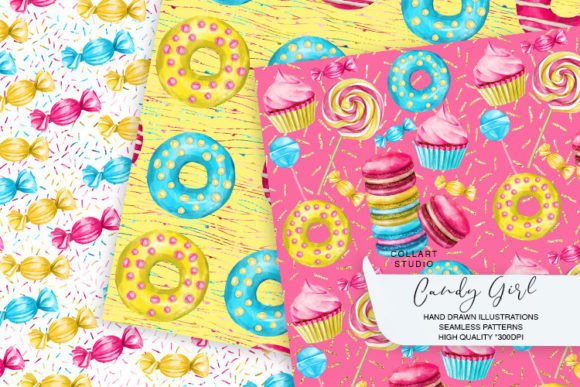
The three included patterns reflect deliberate stylistic cohesion: soft watercolor textures, gentle contrast, and balanced negative space. None rely on heavy saturation or aggressive gradients that risk visual fatigue over large areas. One features delicate candy-colored confections arranged in rhythmic clusters; another uses abstract organic shapes with muted pastel washes; the third combines fine-line botanical motifs with translucent overlays. All retain legibility and tonal harmony whether viewed at thumbnail size on a blog sidebar or scaled to full-page coverage in a printable planner layout.
This level of tactile authenticity—achieved through hand-painted originals rather than vector approximations—gives the papers subtle irregularities: slight pigment pooling, faint paper grain, and nuanced blending. These aren’t flaws; they’re cues that signal human authorship and material awareness. For designers working with audiences that value craft and intentionality—think educators creating classroom resources, small-batch stationery brands, or wellness bloggers curating mindful digital tools—those details reinforce credibility and warmth.
Real-World Use Cases and Workflow Integration
Because each file arrives as a standalone 300 dpi, 12×12 inch JPEG or PNG (typical delivery format), integration is straightforward across platforms:
- Planner stickers: Import directly into sticker design apps (like Sticker Mule’s editor or Silhouette Studio) and resize without pixelation. The seamless nature allows borderless tiling across multi-page weekly spreads.
- Web and blog design: Apply as subtle background textures behind text blocks or section dividers. Their low-contrast palette ensures readability while adding depth—unlike busy stock patterns that compete with content.
- Scrapbooking and invitations: Print on matte or textured cardstock without visible tiling seams, even across folded invitation suites or layered album pages.
- Fabric or paper patterning: Scale to industry-standard repeat sizes (e.g., 24×24 inches) using interpolation-aware resampling—retaining clarity for laser-cut stencils or screen-printed runs.
- Decoupage and mixed media: Print on decal paper or vellum; the watercolor base translates well to dimensional layering without overwhelming underlying surfaces.
For freelancers managing tight deadlines, this predictability reduces revision cycles. A marketer designing a limited-edition product launch kit can confidently build layouts knowing the background texture will behave identically across email banners, social tiles, and printable PDFs—no last-minute asset swaps required.
Who Benefits Most—and When It Might Fall Short
Candy Seamless Patterns, Digital Paper serves creators who prioritize aesthetic continuity, production efficiency, and tactile authenticity—but it’s not a universal solution. It excels for users whose work emphasizes cohesion over variety: a teacher building a year-long themed lesson planner, a boutique wedding stationer developing a signature suite, or a content creator establishing a recognizable visual language across digital touchpoints.
It’s less suited for teams needing dozens of coordinated patterns or highly technical specifications (e.g., Pantone-matched CMYK separations for commercial printing, SVG vector variants, or animated web-ready formats). Likewise, if your workflow depends heavily on parametric customization—changing colors dynamically via CSS variables or adjusting scale non-destructively in Figma—these static raster files won’t accommodate those needs without additional editing steps.
That said, their simplicity is also a strength. There’s no subscription, no usage caps, no licensing ambiguity—just three ready-to-deploy assets with perpetual use rights for personal and commercial projects. For solopreneurs balancing budget constraints with brand integrity, that clarity avoids hidden costs or legal overhead often tied to stock libraries.
Long-Term Utility and Adaptability
Digital papers like these age well—not because they’re trendy, but because they’re built on foundational design principles: rhythm, restraint, and material honesty. Unlike trend-driven assets that feel dated within months, Candy Seamless Patterns, Digital Paper leans into timeless qualities: soft color relationships, hand-drawn imperfection, and scalable repetition. They integrate cleanly with both minimalist and richly layered compositions, adapting to shifts in your visual strategy without requiring replacement.
In practice, this means a blogger who starts with simple blog headers may later repurpose the same pattern for podcast cover art, workshop handouts, or merchandise mockups—all while maintaining visual continuity. An educator might begin with printable flashcards and expand into classroom posters and parent newsletter templates, using the same underlying texture to unify disparate materials. That cross-project utility compounds value over time, especially compared to single-use graphics purchased individually.
One realistic note: while the 300 dpi resolution supports high-quality print up to 12×12 inches at native size, extreme enlargement (e.g., billboard-scale murals) would require professional upscaling with AI-assisted tools or custom redrawing—beyond the scope of the original files. But for 95% of common applications—from A4 printables to Instagram story templates—that limitation rarely applies.
If your work involves translating thoughtful design into tangible outputs—whether digital interfaces, printed collateral, or physical crafts—Candy Seamless Patterns, Digital Paper offers quiet reliability. It doesn’t shout for attention; it supports intention. And in a landscape crowded with disposable assets, that kind of steady, well-executed utility remains uncommon—and quietly valuable.